
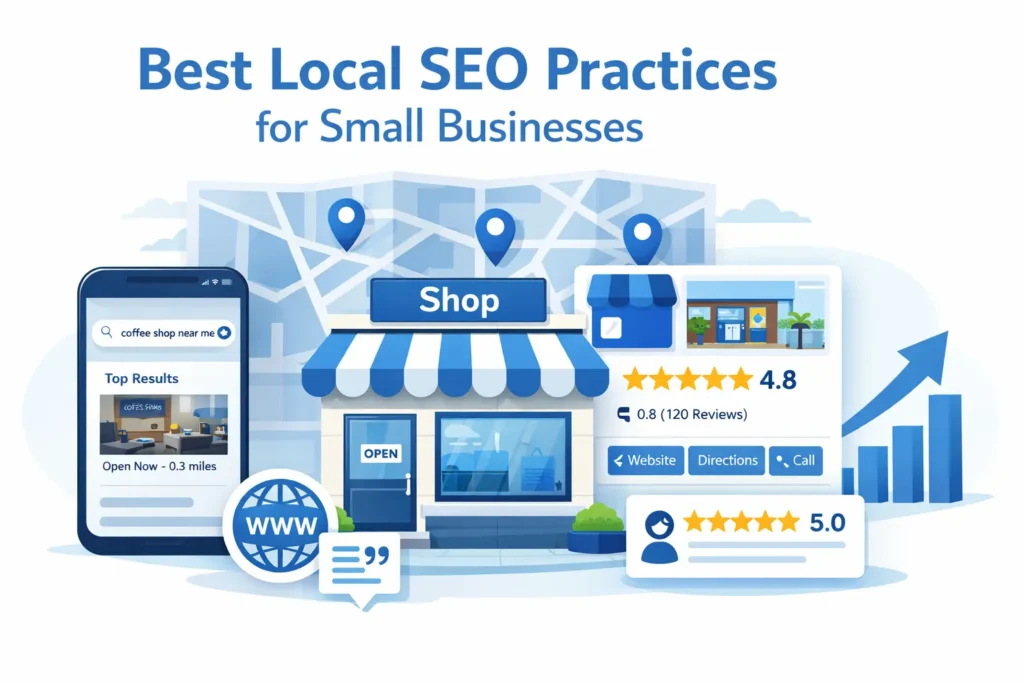
When customers search for services near them, your business needs to appear at the top. Local Google search optimization connects you with ready-to-buy customers in your community. With 76% of people who conduct a near me search visiting a business within 24 hours, mastering the best local SEO practices for small businesses isn’t optional—it’s essential for survival.
This guide covers everything you need: Google Business Profile optimization, citation building, review generation, geo-targeted keywords, and local link building strategies that actually work in 2026.
Local SEO differs fundamentally from traditional SEO. While regular SEO targets broad national rankings, local search optimization focuses on customers in your specific area. Success depends on proximity, local relevance, and your Google Business Profile rather than just website authority.
The numbers speak clearly: 46% of Google searches have local intent, and 28% of local searches result in purchases. For small businesses competing against larger chains, local SEO levels the playing field by capturing customers actively seeking what you offer nearby.
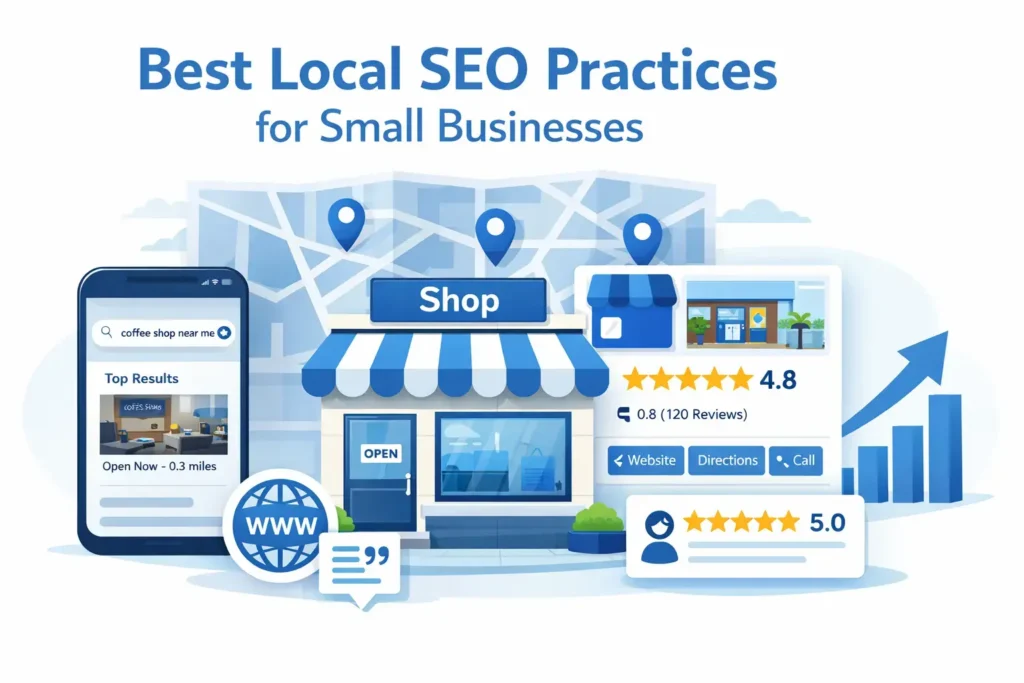
Your Google Business Profile (formerly Google My Business) is the foundation of local SEO strategy. Businesses with complete profiles are 2.7 times more likely to be considered reputable and 70% more likely to attract visits.
Complete every profile section:
Stay active with weekly updates:
💡 Quick Win: Add 10 high-quality photos to your profile today. Businesses with photos receive 42% more direction requests.
Citations—online mentions of your business name, address, and phone number—help Google verify your business exists and determine your rankings. Citation building remains one of the most effective local SEO tactics.
Maintain NAP consistency everywhere: Your information must be identical across all platforms. “123 Main Street” on one site and “123 Main St.” on another confuses search engines and damages rankings.
Where to build citations:
Citation management strategy: Create a master NAP document with exact formatting. Audit existing citations quarterly and fix inconsistencies immediately. Start with aggregators for maximum reach, then add industry-specific and local directories.
Reviews are among the top three local SEO ranking factors. Businesses with more positive, recent reviews rank higher and convert better—93% of consumers read reviews before visiting businesses.
Build a review generation system:
Your request script: “We’re glad you chose us! Your feedback helps us improve and helps others find us. [Direct review link]”
Respond strategically:
Avoid these violations: Never incentivize reviews, post fake reviews, or ask friends/family for reviews without genuine service. Google detects manipulation and penalties are severe.
💡 Quick Win: Generate your direct Google review link and text it to your last 5 satisfied customers this week.
Location-based keywords capture customers searching in your area. Proper keyword research and implementation form your local search optimization foundation.
Identify target keywords:
Implement naturally:
Location page essentials: Each area you serve needs unique content including local landmarks, area-specific services, neighborhood testimonials, embedded maps, and local phone numbers.
Content marketing demonstrates local expertise and earns links while building trust with your community.
High-impact content ideas:
Optimization tactics: Incorporate location keywords naturally, embed Google Maps on location pages, add location to image alt text, implement local schema markup, and link internally between related local content.
💡 Quick Win: Write one blog post featuring 5-10 local businesses you recommend. Tag them on social—this often generates shares and backlinks.
Backlinks from local websites signal community establishment and boost local rankings significantly.
Effective link building strategies:
Quality over quantity: One link from a respected local news site beats dozens from irrelevant directories. Focus on authentic relationships—genuine community connections naturally produce links over time.
Avoid: Never buy links, participate in excessive link exchanges, or spam low-quality directories. These practices risk penalties that devastate rankings.
73% of local searches happen on mobile devices. Your strategy must accommodate on-the-go users seeking immediate solutions.
Mobile optimization:
Voice search optimization: People speak differently than they type. Optimize for conversational questions:
Month 1 – Foundation:
Month 2 – Expansion:
Month 3 – Growth:
Ongoing maintenance:
Track these metrics:
Calculate ROI: (Revenue from local SEO – Costs) / Costs × 100
Most businesses see 3:1 to 10:1 ROI once established, making local SEO one of the highest-return marketing investments available.
A Portland coffee shop competing with nearby Starbucks implemented these strategies over six months. They optimized their Google Business Profile with weekly posts and professional photos, grew reviews from 23 to 187, created blog content featuring local artists, and built community partnerships.
Results: Direction requests increased 150%, phone calls up 200%, rankings improved from page 3 to local pack, and monthly revenue grew 35%. The key? Authentic community involvement and consistent online engagement.
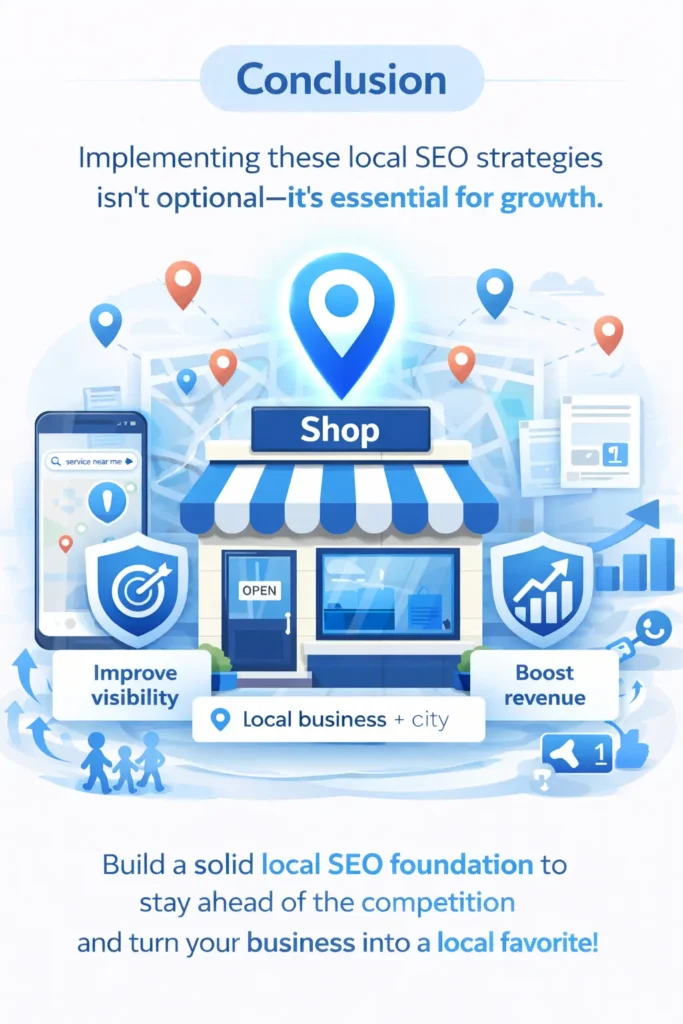
The best local SEO practices for small businesses in 2024 emphasize authenticity, consistency, and genuine community engagement. Search engines reward businesses demonstrating real local connections through reviews, content, and accurate information across the web.
Your advantage isn’t just implementing tactics—it’s doing them authentically over time. Chains can’t replicate your personal customer relationships, neighborhood knowledge, or generational local expertise.
Start with your Google Business Profile today. Just optimizing this free tool and generating 50 authentic reviews puts you ahead of most competitors. Build systematically from there, and you’ll create sustainable local search visibility that drives customers for years.
Local SEO isn’t a one-time project—it’s an ongoing commitment to being findable, trustworthy, and valuable to your community. That investment compounds year after year, creating competitive advantages others struggle to overcome.
Take action today: Choose one task from the 90-day plan and complete it this week. Six months from now, you’ll see the transformative power of consistent local SEO effort on your business’s visibility and growth.
"Adcrue: Driving Digital Success, One Strategy at a Time"
Address : Siddharth Vihar Ghaziabad, 201009
Phone : +91 87449 96638
Copyright © 2025 All Rights Reserved
Connect Us